
Grief manifests in countless ways. For some, it is a quiet, solitary sorrow. For others, it is a roar into the storm. The Freddie Mercury Tribute Concert in 1992 was, on a global scale, the latter—a cathartic, collective scream of love and loss for one of rock’s most irreplaceable voices. Within this historic event, the performance of “Tie Your Mother Down” by the surviving members of Queen, joined by Slash and Joe Elliott, stands as a perfect case study in how a tribute can transcend mere nostalgia to become a powerful, defiant act of reclamation. It was not an attempt to replicate Freddie, but to honor him by fiercely protecting the rebellious, joyous spirit he embodied.
The performance’s power was rooted in its foundational truth: the remaining members of Queen were not a backing band; they were the keepers of the flame. Brian May’s iconic opening riff, played on that stage, was loaded with a new, profound meaning. It was no longer just a hard rock intro; it was a declaration of survival, a sound that had outlived its creator. By launching into one of their most raucous and playful anthems, they made a conscious choice. They chose not a ballad of mourning, but a song of pure, unapologetic rock and roll energy. This selection was a statement: Freddie’s legacy was one of joy, power, and irreverence, and to honor him truly was to embody that spirit, even through the pain.
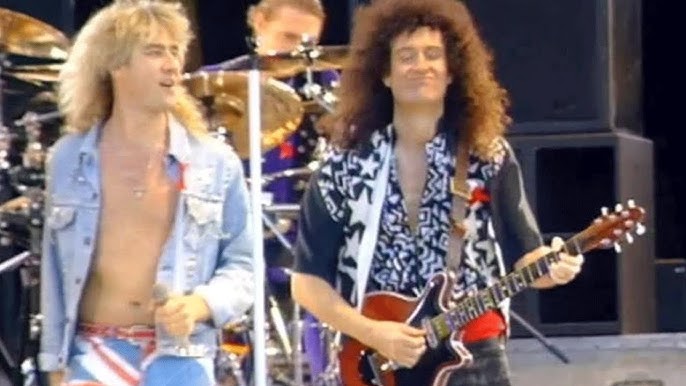
The choice of guest artists was equally masterful. Joe Elliott, as the frontman of fellow British rock titans Def Leppard, represented the voice of a peer and a fan. He did not attempt Freddie’s unique vocal gymnastics; instead, he delivered the lines with a powerful, stadium-rock sincerity, representing every artist and every fan in the crowd who had been inspired by Mercury. He was the everyman, paying his respects with a clenched fist and a raised voice. Slash, meanwhile, provided the performance’s searing, wordless poetry. His extended solo was the emotional core of the piece—a wailing, gritty, and technically stunning expression of what words could not capture. His guitar didn’t just play notes; it wept, it raged, and ultimately, it triumphed, weaving a narrative of loss and celebration that filled the space where Freddie’s voice would have been.
The imagined backstage moment—Brian May’s tearful assertion that “He would have loved that”—encapsulates the entire philosophy of the performance. It was about capturing the essence of the man, not replicating his image. The “chaos” and the “noise” were not imperfections; they were the point. They were the sound of life stubbornly continuing, of a band and a global community refusing to let the music be silenced by death.
In the end, this performance of “Tie Your Mother Down” taught a vital lesson about public grief and artistic legacy. It demonstrated that the most profound tribute is not always a somber whisper, but can be a joyous, deafening roar. It proved that a song, when played with the right intention, can become a shield against oblivion. The power chord, screaming into the Wembley night, was not a sound of finality, but a promise that the show, in some form, must and would go on.
