Marcel Reed’s Night in Austin: How One Brutal Loss Defined a Season, a Team, and a Quarterback
Marcel Reed walked out of Austin carrying more than a loss; he carried the weight of an entire season that slipped through Texas A&M’s fingers in the space of four quarters. On paper, the final score was just another number in a rivalry ledger. In the locker room, it was a scar. For two months, the Aggies had been a story of resilience, transformation, and discipline—a team that clawed its way to an 11–1 regular season, defying expectations and silencing doubters week after week. But in Austin, under the brutal lights of a playoff-deciding stage, everything unraveled.
The sophomore quarterback, who had been showered with praise for his poise, found himself at the center of the storm. Two interceptions—one in the second quarter on a misread coverage, and another in the dying minutes when desperation overrode caution—turned the tide of the game. And when the clock hit zero, the playoff dreams that felt almost inevitable dissolved instantly, as if someone had flipped a switch on an entire season of belief.
Reed did not run from the moment. Many young quarterbacks faced with a loss of that magnitude might have ducked the cameras, hidden in their locker, or leaned on vague clichés to escape responsibility. Reed chose a different path. He stood in front of reporters, shoulders squared, eyes red but unbroken, and spoke plainly.\

“We got outplayed,” he said, his voice steady. “Sometimes things don’t work out your way.”
The simplicity of the words belied the magnitude of what had happened. Aggie fans had watched their team roll through the fall like a machine—balanced offense, punishing defense, and Reed at the wheel, weaving the calm confidence of a veteran with the athletic burst of a rising star. They watched him dismantle LSU, out-duel Ole Miss, and convert impossible third downs with a smirk that bordered on reckless optimism. The Texas game was supposed to be the statement, the signature, the stamp on a playoff ticket.
Instead, it was a lesson.
Texas blitzed Reed early and often, daring him to stay comfortable in the pocket. Their secondary baited throws, shifting coverages late, disguising man and zone looks like sleight of hand. The Longhorns didn’t simply beat A&M—they suffocated them. Every yard felt earned with blood and grit. Every possession carried the tension of a team walking a tightrope with no safety net below.
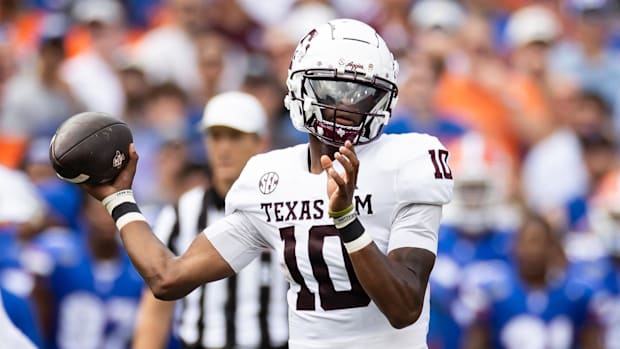
The turning point came halfway through the fourth quarter. Trailing by six, Reed orchestrated a drive that electrified his sideline. Quick outs, hard slants, a fourth-and-two scramble that saw him dive under a linebacker. It was vintage Aggies: fearless, relentless, inevitable. And then came the dagger. On second and goal, Reed looked left, thought he saw a window, and fired into a trap disguised as zone. Texas corner Jaxon Lyte jumped the route before the ball had even left Reed’s fingertips. He ran 87 yards the other way, turning a potential lead into a double-digit deficit that snatched the breath from Aggie fans.
Reed collapsed to one knee, helmet pressed against the turf as the stadium erupted. The mistakes were painfully public, broadcast in high definition and replayed endlessly on social media. But what followed was something that coaches, former players, and rivals respect more than talent: accountability.
“We fought,” he said later in the postgame presser. “Nobody quit. Nobody walked off. We played this game the way we’ve played all year—with heart. I made mistakes, and I’ll own that. But these guys? They battled.”

There were no excuses, no subtle criticisms of play-calling, no coded frustration about his receivers or offensive line. Instead, he saluted his locker room—offensive linemen who had protected him all season, a defense that had carried games when the offense sputtered, and coaches who had believed in him from the beginning.
That willingness to absorb the pain says something about Reed the player, and Reed the person. College football is a pressure cooker that rewards swagger and ruthlessness. Quarterbacks are elevated as superhuman when they succeed and torn down as fragile imposters when they fail. Reed didn’t try to posture. He didn’t hide behind bravado. He spoke like a teammate, not a brand.
Head coach Adam Jenkins echoed that sentiment. “Marcel has been our heartbeat,” Jenkins said. “He’s going to learn from this. And if you think we’re done? If you think this was our ceiling? Then you haven’t been in our locker room.”
There was no bitterness in Reed’s tone—only clarity. A sense that he understood this loss not as a collapse, but as a moment that would define the next step. Twelve months earlier, he was a wide-eyed freshman fighting for snaps. Now, he was the face of a program whose every win and every heartbreak would be measured against his performance.
The locker room stood behind him. Linebacker Nate Hammond, a senior who played his final rivalry game, put an arm around Reed’s shoulder after the press conference. “You win with your quarterback,” he said. “You lose with your quarterback. And you ride with him every time.”
That’s the reality of college football: it is never only about the scoreboard. It is about how a quarterback walks off the field—head down in shame, or eyes forward with something still burning. Reed chose the latter. And in that choice lies the difference between a season that ends in disappointment and a legacy that begins in adversity.
The Aggies may have fallen short in Austin, but they didn’t collapse. They cracked, exposed their flaws, and watched a dream slip through their fingers. And in the wreckage, their young leader stood tall and promised they would return—not with excuses, but with fire.
For now, the stadium lights in Austin are off, the rivalry game is over, and the playoff picture moved on without them. But the next season began the moment Marcel Reed walked out of that locker room and refused to let defeat bury him.
