Georgia Wins, Offense Stalls: What the Bulldogs’ Latest Performance Really Reveals
In college football, not all wins are created equal — and Georgia’s most recent victory might be the clearest example of that truth. The Bulldogs walked off the field with a “W,” but it was a performance that defied the identity many have come to expect from Kirby Smart’s powerhouse program. While the scoreboard favored Georgia, the details of the game painted a more complicated picture: an elite defense in full championship mode paired with an offense stuck in neutral.
This wasn’t just another game on the schedule. It was a measuring stick moment. And the results, depending on which side of the ball you examine, tell very different stories.
Defense in Playoff Mode
If one unit validated Georgia’s championship aspirations, it was unquestionably the defense. From the opening snap, the Bulldogs played with a level of discipline, speed, and awareness that has become synonymous with the Smart era. The front seven applied steady pressure, forcing the opposing quarterback into rushed throws and limiting explosive plays. Linebackers flowed downhill with precision, while the secondary closed passing windows before they fully developed.

This wasn’t just good defense — it was playoff-caliber defense.
What stood out most was how Georgia consistently dictated the terms of engagement. The defense never felt reactive; instead, it controlled the tempo, the spacing, and the psychology of the opposing offense. Even when the Bulldogs’ offense repeatedly failed to sustain drives, the defense refused to bend under the extra workload. They tackled in space, communicated flawlessly on pre-snap motion, and played with a level of physicality that suggested a team preparing for far bigger battles ahead.
If Georgia goes deep in the postseason, analysts may look back on this game as evidence that its defensive DNA is still strong enough to carry them into championship contention.
Offense Exposed — Not Just “A Bad Day”
But the praise stops there.
Georgia’s offensive showing was the worst of the season: lowest scoring output, fewest total yards, and an eye-opening lack of creativity. This wasn’t an off day — it was a performance that exposed structural issues. Problems that had been simmering beneath the surface were suddenly impossible to ignore.
The offense lacked rhythm. Drives stalled early and often. There was no consistent identity — no bread-and-butter concept the team could rely on when it needed momentum. The play-calling felt conservative and predictable, giving the opposing defense little reason to respect vertical threats. Meanwhile, Georgia’s skill players struggled to generate separation or create explosive plays after the catch, leaving the quarterback with limited options and forcing the team into third-and-long scenarios all night.
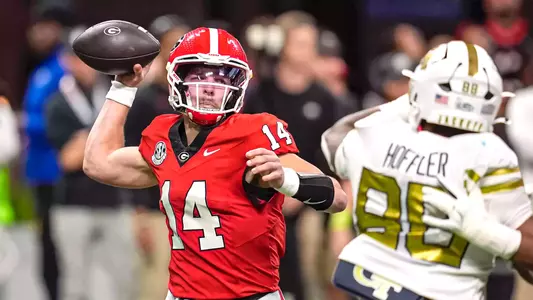
Kirby Smart did not sugarcoat the situation during his postgame remarks, delivering a line that carried unmistakable weight: “Got to continue to get better.” Coming from a coach who chooses his words carefully, the message was clear. Georgia does not have an offense capable of weathering elite competition — at least not yet.
The Bulldogs’ offensive ceiling remains an open question. Without more dynamism, more playmaking, and more urgency, this unit risks becoming the liability that caps Georgia’s championship potential.
Is This a Sustainable Formula for Winning?
In short: no.
Defense-only formulas do not survive deep into championship runs. The modern college game requires balance, and championship teams almost always feature offenses capable of answering pressure with pressure, scoring with urgency, and dictating tempo. Georgia’s defense can win matchups, perhaps even entire games, but it cannot compensate for offensive stagnation over the long haul.
The schedule ahead includes teams with high-powered offenses, innovative play-callers, and quarterbacks who thrive in chaos. If Georgia rolls into those matchups with the same offensive issues displayed in this game, the Bulldogs won’t merely struggle — they’ll be vulnerable.
That is the underlying concern: this team cannot rely on defense as a life raft indefinitely. Eventually, the offense must carry its share of the load.
Still — A Win Is a Win
But amidst the criticism lies an important truth: Georgia won. And sometimes, winning the ugly games is what separates great programs from merely good ones. Championship teams are forged not only through dominating performances but also through gritty, imperfect victories where resilience, not finesse, determines the outcome.
In that sense, this game was a test of Georgia’s backbone. How does a team respond when one entire side of the ball sputters? How do players adjust, communicate, and stay composed when momentum tilts against them? Georgia answered those questions with toughness and discipline.
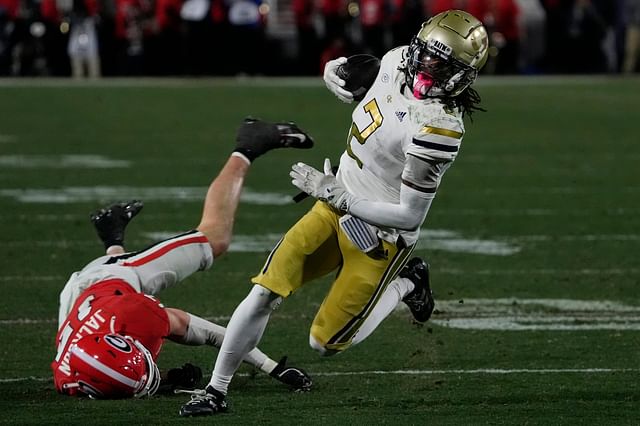
Championship runs are rarely linear. They are built through moments like this — games that reveal flaws but also showcase character. For Georgia, this victory might serve as a wake-up call at precisely the right time.
So What’s the Message?
Georgia’s performance sends a message with two sides:
-
The defense is legitimate, elite, and capable of anchoring a championship-caliber team.
-
The offense, however, must evolve — immediately — if the Bulldogs hope to survive what lies ahead.
The Bulldogs escaped this time. Whether it was grit, luck, or pure defensive dominance depends on perspective. But the next chapters of the season will reveal whether they are truly built for another title run or simply avoiding disaster week by week.
As the debate continues, one thing is certain: Georgia is entering a defining stretch, and the answers will come soon enough.
